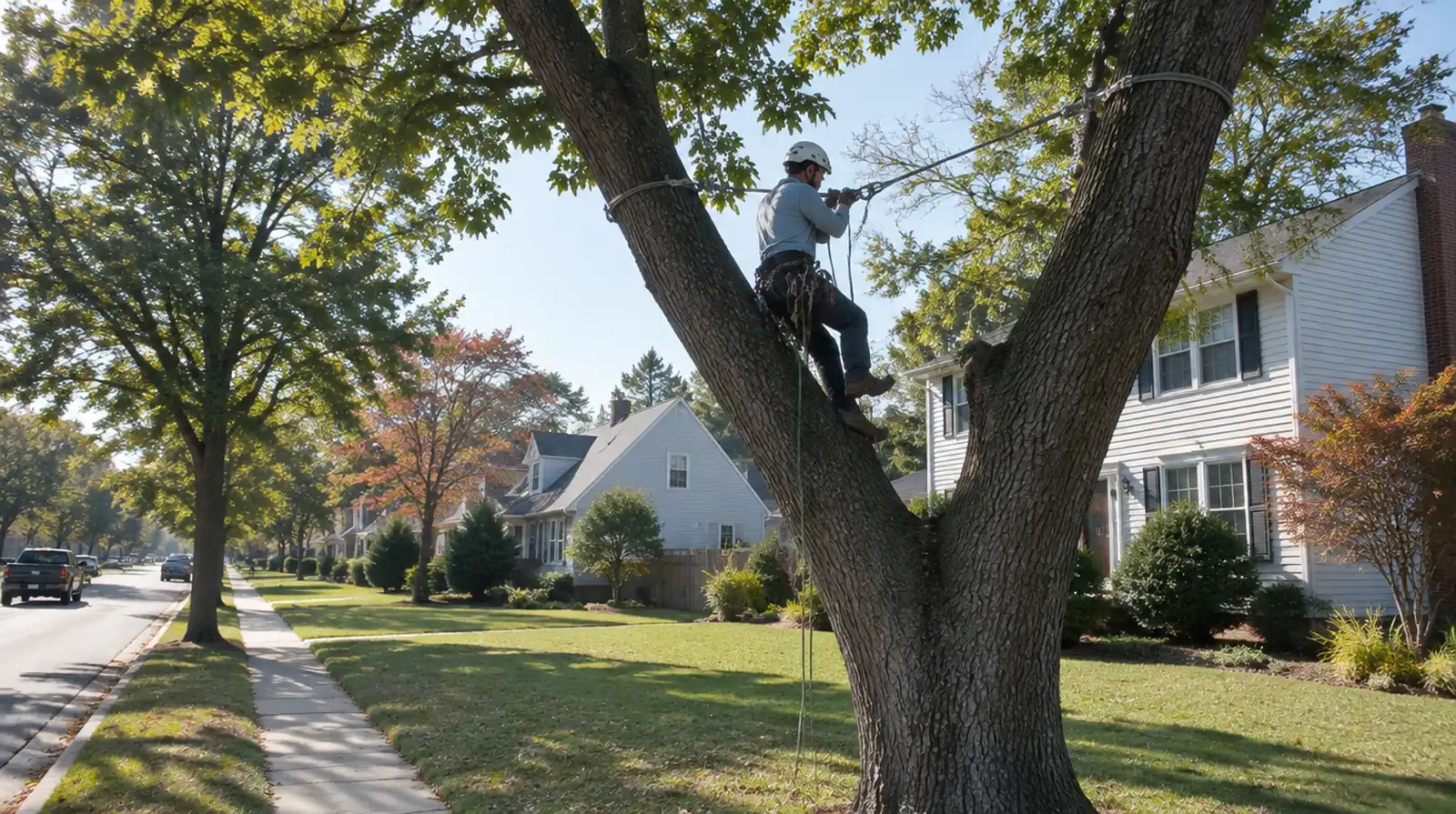
What does tree cabling involve?
A climber installs threaded steel anchors in the limbs, about two-thirds of the way from the weak joint up toward the branch tips. A high-strength steel cable runs between those anchors, snug without being tight, so the limbs can still move a little in the wind. For a trunk that has already cracked, a brace rod bolted through the split holds the two sides together lower down. Most cabling jobs include a light trim to take weight off the heaviest limbs.
When does a tree need cabling?
Cabling is used on trees with two or more trunks joined in a tight V, especially if you can see a dark seam or oozing where they meet. It also supports long, heavy limbs stretched over a house or patio, and trees with an old crack that hasn't grown. Silver maples, red maples, and multi-trunk oaks are the trees that need it most often in local yards.
Why do weak branch joints form?
When two stems grow up side by side, bark gets pinched between them where wood should be. This is called included bark, and it keeps the stems from truly fusing. The joint looks solid but has a fraction of the strength. Add ice on the branches, or wind after rain has softened the clay around the roots, and the stems start pulling apart. Young trees can be pruned so it never happens. Mature trees need hardware.
What affects the cost of tree cabling?
Cost depends on how many cables and brace rods the tree needs, how high the anchor points are, and whether the tree also needs trimming to reduce weight. Cables should be inspected every few years and adjusted as the tree grows. Every piece of hardware is listed and explained in the free written estimate.
Should you cable the tree or remove it?
Cabling makes sense when the tree is healthy and the weak spot is limited to one or two joints. It won't fix rot, dying roots, or a trunk that is already splitting wide open. In those cases a cable only buys a little time, and cutting the tree down in sections is the responsible call. A cable supports a good tree. It can't make a failing tree safe.
What do people ask about tree cabling?
Does drilling for cables hurt the tree?
The holes are small, and a healthy tree seals off the wood around them. That minor wound does far less harm than a trunk splitting in half, which usually ends with the whole tree coming down.
How long does a cable system last?
Steel cable and hardware can last for decades. The tree keeps growing, though, so the system should be checked every few years and loosened or moved higher when needed.
Does cabling guarantee the tree won't break?
No system can guarantee that. Cabling greatly reduces the chance of a weak joint failing in normal storms. A severe storm can still damage any tree, which is why cabled trees need regular checkups.
Cabling the big old trees on Woodbridge lots
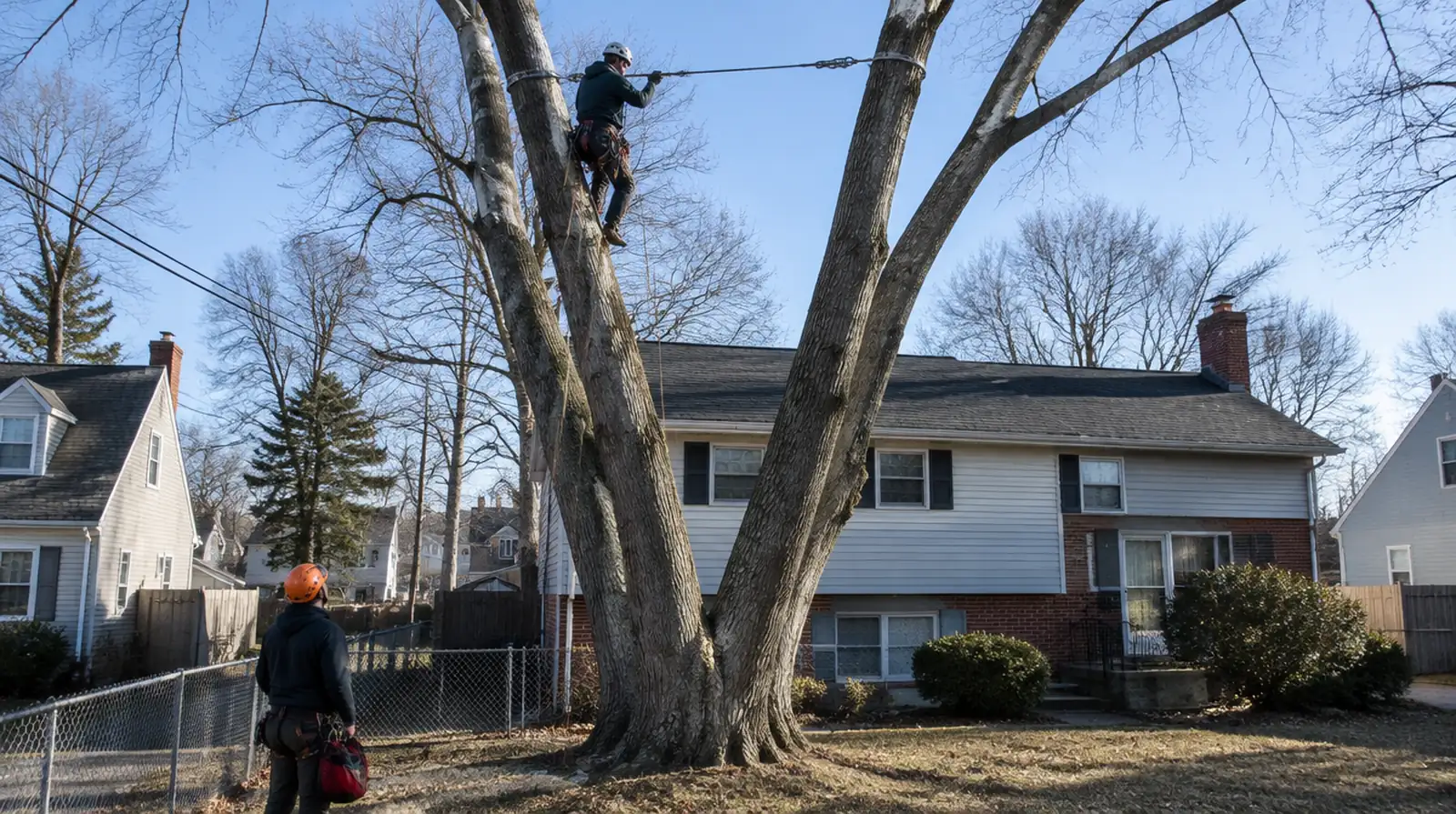
Much of Woodbridge filled in after the war, and the pin oaks, silver maples and red maples planted along those blocks now stand taller than the houses. Silver maples in particular like to grow several trunks from one low point, and on a narrow lot those trunks often lean over the roof on one side and the neighbor's garage on the other. That is the kind of tree where a cable between the leaders can make sense, provided the base and the roots are sound.
Heavy wet snow and ice are the loads we think about most here. An early nor'easter that drops wet snow while trees still hold some leaves, or a January ice storm, puts weight on every limb at once. A failing joint usually shows itself the morning after, as a fresh crack running down from the crotch.
If a tree on your property already has a cable from years ago, it deserves a look. Hardware a previous owner put in may sit in the wrong spot now that the tree has grown, or the cable may have gone slack. We check the anchors, the tension and the wood around them, then tell you whether it should be adjusted, replaced or left as it is.
Noticed a crack at the joint after a storm? Keep people and parked cars out from under that side of the tree until someone has looked at it.